
There’s a certain excitement that comes with pulling away in the motorhome, knowing another little adventure is about to begin. This time, trip number five took us to West Runton on the North Norfolk coast, where we stayed for four nights from Tuesday, 25th May.
📍 West Runton Caravan and Camping Site
Holgate Lane, Cromer, NR27 9NW
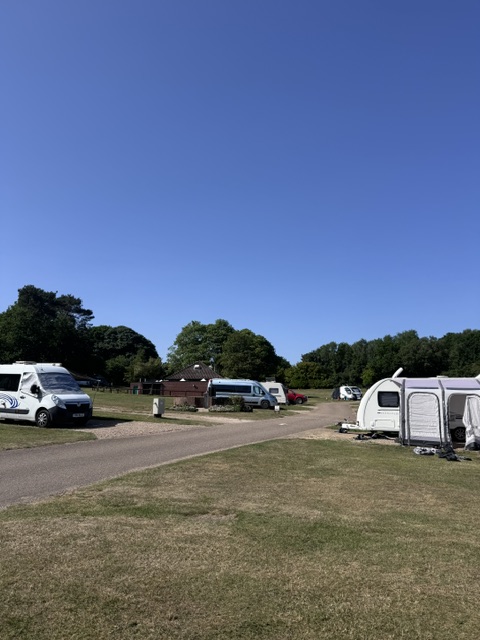
Before you even arrive, the campsite gives you a taste of adventure. Holgate Lane is long, narrow, and definitely not designed for nervous drivers. The passing places are tight enough already, so the site’s rule about not arriving before 1 pm suddenly makes perfect sense. Meet another motorhome head-on and you’d have a proper situation on your hands.
The campsite itself is very basic. It’s essentially a large field with two toilet blocks and a small kiosk selling ice creams, long-life milk, bottled water and cans of pop. If you’re looking for luxury, this isn’t the place. But if you want a brilliant base for exploring West Runton, East Runton, Cromer and Sheringham, it works perfectly. What the site lacks in facilities, it makes up for in location.
On Wednesday morning, we took the woodland path near the kiosk and headed towards East Runton. It’s a lovely walk, around twenty to twenty-five minutes, with deer grazing quietly in the fields and birdsong following you the entire way. Near the entrance is a small information hut filled with walking maps, bus timetables and details of local wildlife. Apparently, almost a hundred bird species have been catalogued in the area.
As you enter East Runton, you pass a beautiful pond before reaching the village itself. One thing I noticed straight away was the stonework. Many of the walls are built from rounded beach stones, almost like cobbles, held together with mortar. They give the village so much character, as though the coastline itself has been worked into the buildings.
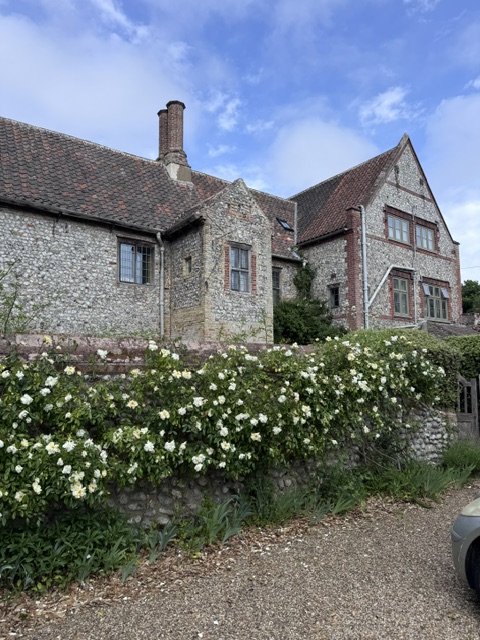
East Runton is small but charming, with a village shop, pub and post office, along with plenty of holiday cottages and campsites nearby. Surrounded by countryside and coastal paths, it’s ideal for walkers and cyclists.
From East Runton beach, we carried on walking all the way to Cromer. The pier stayed in sight almost the entire journey, pulling us forwards, and before long we arrived ready for a well-earned cuppa.
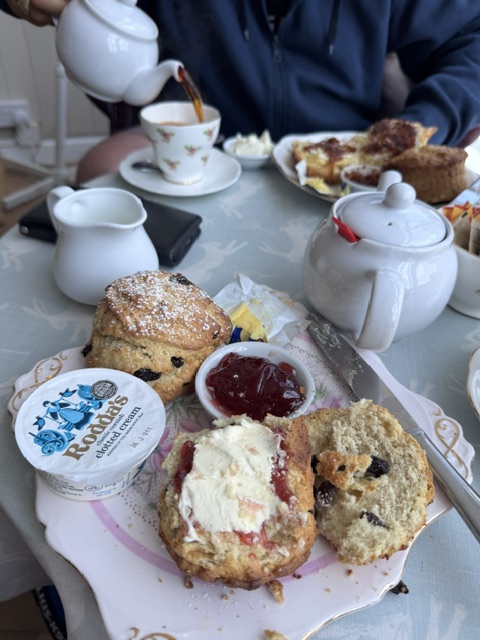
Cromer is exactly what you want from a traditional seaside town. Independent shops selling glassware, paintings of the sea, postcards and seaside trinkets line the streets. There’s a relaxed atmosphere that makes you slow down without realising it. We stopped at Hattie’s Tea Room for a cream tea and honestly, it was worth every calorie. You get the choice of two fruit scones with jam and clotted cream, or cheese scones served with cream cheese and chutney. Yes, two scones. No regrets. They were delicious!
On the way home, Andy decided we should stay on the bus until West Runton and attempt to walk back to the campsite from there. That turned into an accidental extra hike after we took the wrong turning and got completely lost. Thankfully, we eventually found our bearings and made it back without too much grumbling.
Thursday was another walking day. We headed back through East Runton before catching the bus to Sheringham to meet family for lunch. Sheringham feels busier than East or West Runton, with a lively high street, plenty of cafés, pubs and independent shops, plus a beautiful beach. There’s also a train station right on the main street, adding to its old-fashioned seaside charm. We had lunch at The Robin Hood pub before spending some time wandering around the town. It has a lovely atmosphere and definitely feels like somewhere you could happily spend an entire day exploring.
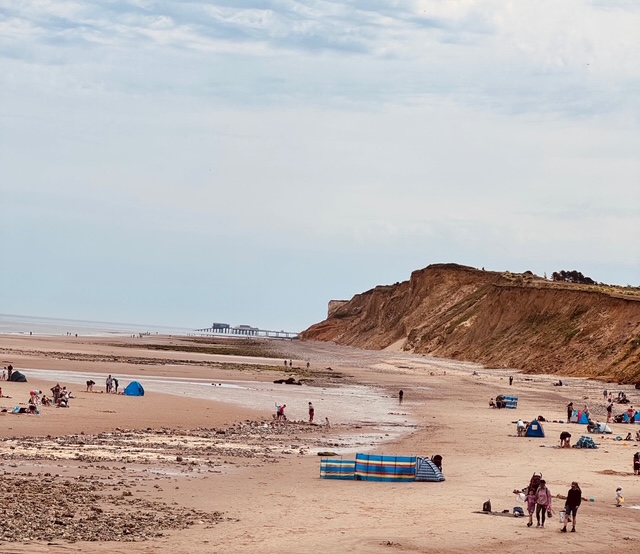
Friday brought another long walk, this time taking the upper right-hand path from the campsite towards West Runton beach. After around twenty-five minutes, we reached Water Lane, followed by another fifteen-minute walk down to the coast. West Runton beach is rugged and beautiful, scattered with rock pools and small stones beneath towering cliffs. It’s also famous for its fossils.
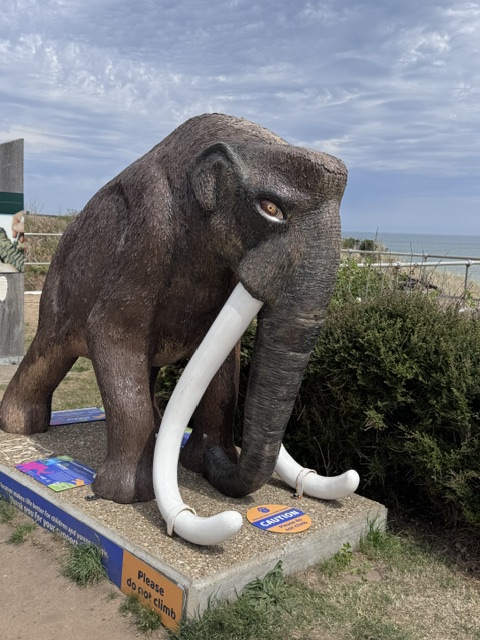
The cliffs here were once part of the Cromer Forest Bed formation, dating back between 700,000 and 500,000 years. Fossils of animals, birds and insects are still uncovered as the cliffs gradually erode. Perhaps the most famous discovery happened after a storm on 13 December 1990, when local residents Margaret and Harold Hems spotted a large bone exposed beneath the cliffs. Experts later identified it as part of a steppe mammoth, now known as the West Runton Mammoth. There’s information near the beach explaining the discovery, along with a mammoth statue overlooking the coastline. Standing there looking up at those cliffs, knowing creatures once roamed this land hundreds of thousands of years ago, gives the place a completely different feeling.
All in all, West Runton turned out to be a fantastic place for walking and exploring. The scenery is beautiful, the coastal paths are brilliant, and there’s plenty to discover nearby. Albi absolutely loved every second of it, and judging by how much walking we did, this holiday certainly kept us fit.
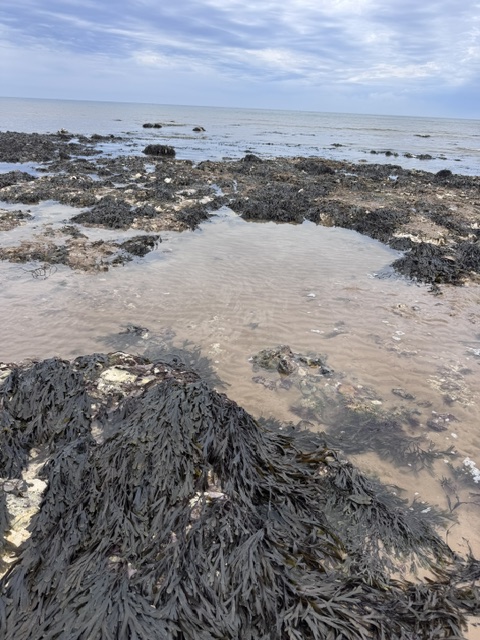
Lots of life in the rockpools
If you’d like to read about our previous motorhome adventures, you can find them below:
Trip 1 – Ullswater, Lake District
https://lynetteswebsiteblog.com/2025/10/08/lynettes-motorhome-travels-first-stop-ullswater-the-lake-district/
Trip 2 – Hoddom Castle, Scotland
https://lynetteswebsiteblog.com/2025/10/22/lynettes-motorhome-travels-2-haddom-castle-scotland/
Trip 3 – Castle Bay, Scotland
https://lynetteswebsiteblog.com/2025/10/29/lynettes-motorhome-travels-3-castle-bay-scotland/
Trip 4 – Tantallon, North Berwick
https://lynetteswebsiteblog.com/2025/11/06/lynettes-motorhome-travels-4-tantallon-north-berwick/


I used to live in Cromer, and love the walk along the beach to West Runton! Lovely to read this 🙂
How lovely to find out a bit about you. ❤️
Cromer is a beautiful part of the country. We used to take the kids crabbing along the pier when they were little.
Great blog, Lynette. Looks like you had a brilliant time. Love the stone buildings, and the beach is gorgeous.
Yes, we did thanks Tricia. It’s nice to know you appreciated the stone buildings too. They really were lovely.
Pingback: Smorgasbord Blog Magazine Weekly Round Up – June 1st-7th – Music, Aging, Cuisine Philippines, The Alexander Technique, Book Reviews, Summer Book Fair and Funnies | Smorgasbord Blog Magazine
Thank you! ❤️
Thank you Sally. More escapades in July when we’re off to Devon.
What fun! (Although I have to admit, my attention was captured by the scones.)
Amazing weren’t they. Believe me when I say they were delicious.